It is not uncommon to learn about another culture through movies or TV dramas, and often overseas audiences are more intrigued and lured by the traditional culture, which is not their own.
Speaking of Hong Kong, the first name foreigners probably mention is Bruce Lee if not Jackie Chan nor Donnie Yen for millennials. Even if you are not a fanatical fan or martial arts practitioner, everyone knows Bruce Lee for his perfect masculinity and impeccable fighting skills. His philosophy and work have left a phenomenal impact not merely within martial arts communities but also beyond cultures and industries.
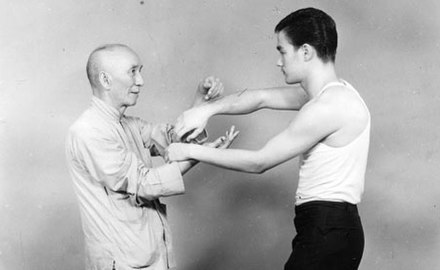
Cocky young boy studied Wing Chun under Ip Man
Bruce was born in San Francisco, California, in 1940 as the second son of a famous Chinese opera star and a beautiful mother of Euroasian origin. After returning to Hong Kong, the young man often labeled as “cocky” was involved in several street fights with local triad members.
Worried father brought his son to the renowned martial arts master Ip Man to study a style called “Wing Chun” for self-defense. Bruce was 16 years old and trained under Ip Man in the late 1950s before his parents finally decided to send him to America. Starting over a new life there would be a better option to avoid trouble, his parents thought.
After a year into his training, many of his classmates at Ip’s kung fu studio became reluctant to train with Bruce. He had a mixed non-Chinese ancestry, and that made other students think Bruce is not qualified. Back in those days, most martial arts schools and masters were exclusive to teach only people of Chinese descent.
Woman-invented Kung fu
The style of martial arts Bruce studied was a unique woman style of kung fu, which originates in Southern Shaolin Temple in Fujian province. Wing Chun means “beautiful spring,” which is, in fact, the name of the female founder Yim Wing-Chun.
The style focuses on defeating enemies as quickly and as efficiently as possible by attacking the centerline of the opponent’s body. In the recent popular movie series “Ip Man 4,” starring Donnie Yen, you can witness how the successor of Hong Kong martial arts hero defeats the American soldiers with the chain punches of economic movement.
It is interesting to see how Wing Chun was popularized by Bruce Lee and the movie industry. Only a handful of people had known the style before Bruce Lee appeared on the screen. Now because of Donnie Yen and Ip Man series, a great many know or hear Wing Chun if not everyone.
From Fujian to Guangdong, then Hong Kong to the world
Legend has it that Wing Chun was passed on from Fujian to Guangdong province by members of Canton opera actors on the so-called “red ship”. Then, it was exported further South when Chinese mainlanders fled to Hong Kong to seek better lives during the cultural revolution between the 1950s to 1970s.
“Wing Chun is an internal soft kung fu, and anyone can learn it” – Lam Shu-Shing
“Wing Chun is a soft internal style of kung fu. It doesn’t count on power generated by muscles, so it’s suitable for women. In fact, Wing Chun was invented by a lady”, explains Lam Shu Shing, Vice-president of Leung Sheung Lineage Wing Chun International Fellow Confederation. Lam started learning Wing Chun at the age of 18 under late Leung Sheung, one of the four significant students of Ip Man.
Master Lam, who is turning 70 this year, teaches the art to a small number of students he carefully chose. He is strictly following the lineage of his teacher. “Wing Chun should be passed down to determined, hardworking students. Because my goal is not only to inherit the skills but also its spirit to next generations”, he says.
Ip Man as well learned Wing Chun from his teacher on a one-on-one basis at his residence. Now a popular martial arts style once was extraordinarily exclusive and hidden from the ordinary public.
Bruce’s statue and Cultural Heritage Museum
Tourists taking photos posing like an action star in front of the statue of Bruce Lee is what you often see at the avenue of stars in Tsim Sha Tsui. A significant number of movie fans from all over the world visit Hong Kong every year, as movie tourism becoming increasingly more popular in recent years. Fans visit shooting sites of their favorite movies and idols and post pictures instantly on social media.
If you want to do a little bit more than taking photos, you can visit Hong Kong Cultural Heritage Museum in Shatin. At the exhibition dedicated to the life of Bruce Lee, visitors can observe his rare personal items such as outfits, training equipment, writings, short movies, etc. You can definitely feel as if you are stepping in time when Bruce Lee was alive.